Key Judgment
Tehrik-e-Taliban Pakistan presents a sustained threat to Pakistani state institutions and to people operating in its core areas. It creates indirect risk to Western interests through regional instability, propaganda, relationships with transnational extremist networks, and the possibility that changes in intent or access could expand its target set. Public evidence supports caution about the group’s ambitions, but does not establish that it currently possesses a mature, sustained capability to conduct attacks in the United States.
Confidence
Moderate. Public reporting consistently documents terrorist activity and kidnapping risk in Pakistan, especially in Khyber Pakhtunkhwa and the former FATA. Confidence is lower when assessing external plotting because reliable public information about intent, operational preparation, and command relationships is limited.
Why It Matters
The most immediate customer question is not whether TTP is globally dangerous in the abstract. It is whether the group changes decisions about personnel, facilities, movement, partners, or crisis posture.
- U.S. personnel and contractors may face elevated exposure when operating near affected areas.
- Attacks on Pakistani security institutions can disrupt transportation, government services, and partner operations.
- Kidnapping and terrorism risk can reduce the margin for error during employee movement.
- A credible shift toward external operations would require a rapid reassessment of Western-facing risk.
The U.S. Department of State currently advises reconsidering travel to Pakistan and identifies terrorism, crime, kidnapping, and armed conflict as principal concerns. It advises against travel to Khyber Pakhtunkhwa, including the former FATA, where active terrorist and insurgent groups routinely operate.
Assessment
Intent
TTP’s primary objectives remain centered on Pakistan: weakening state authority, challenging the government, and expanding its preferred political and religious order. Western influence is part of the group’s ideological narrative, and the group has demonstrated historical interest in U.S. targets. However, hostility alone does not prove a current ability to execute sustained external operations.
Capability
The group’s decentralized structure, access to sanctuary, and ability to survive leadership disruption support continued regional resilience. Its established attack methods—bombings, armed assaults, kidnappings, and targeted attacks—are most relevant inside Pakistan. Capability against distant Western targets should be treated as a collection requirement rather than an assumed fact.
Operational Implication
For an organization moving personnel through Pakistan, geography matters more than a country-wide label. Travel near Khyber Pakhtunkhwa, Balochistan, security installations, political gatherings, and other symbolic targets requires a different posture than routine activity in lower-exposure areas. Restrictions can also change quickly, which makes itinerary visibility and decision triggers essential.
Indicators That Would Change the Judgment
- Credible TTP statements that name Western companies, personnel, or facilities.
- Evidence of operational cooperation with groups that possess external-attack capability.
- Attacks beyond the group’s normal operating area or target set.
- Increased surveillance, probing, or threat reporting around Western-linked locations.
- A leadership change that produces a more explicitly transnational strategy.
- New access to travel documents, facilitation networks, technical expertise, or overseas operatives.
Recommended Actions
- Apply location-specific approval rather than treating all travel to Pakistan as equivalent.
- Monitor State Department and U.S. mission reporting before and during travel.
- Maintain traveler check-in, communications, and emergency-departure plans.
- Avoid predictable movement near security installations, political rallies, and known gathering points.
- Reassess immediately if TTP demonstrates credible Western targeting or activity outside its established operating pattern.
Analytic Limitations
This assessment relies on public reporting. It cannot determine undisclosed plotting, internal leadership deliberations, or the full extent of relationships with other extremist organizations. The judgment distinguishes demonstrated regional capability from possible external intent and should be updated when new operational evidence appears.
Source Notes
- U.S. Department of State — Pakistan Travel Advisory
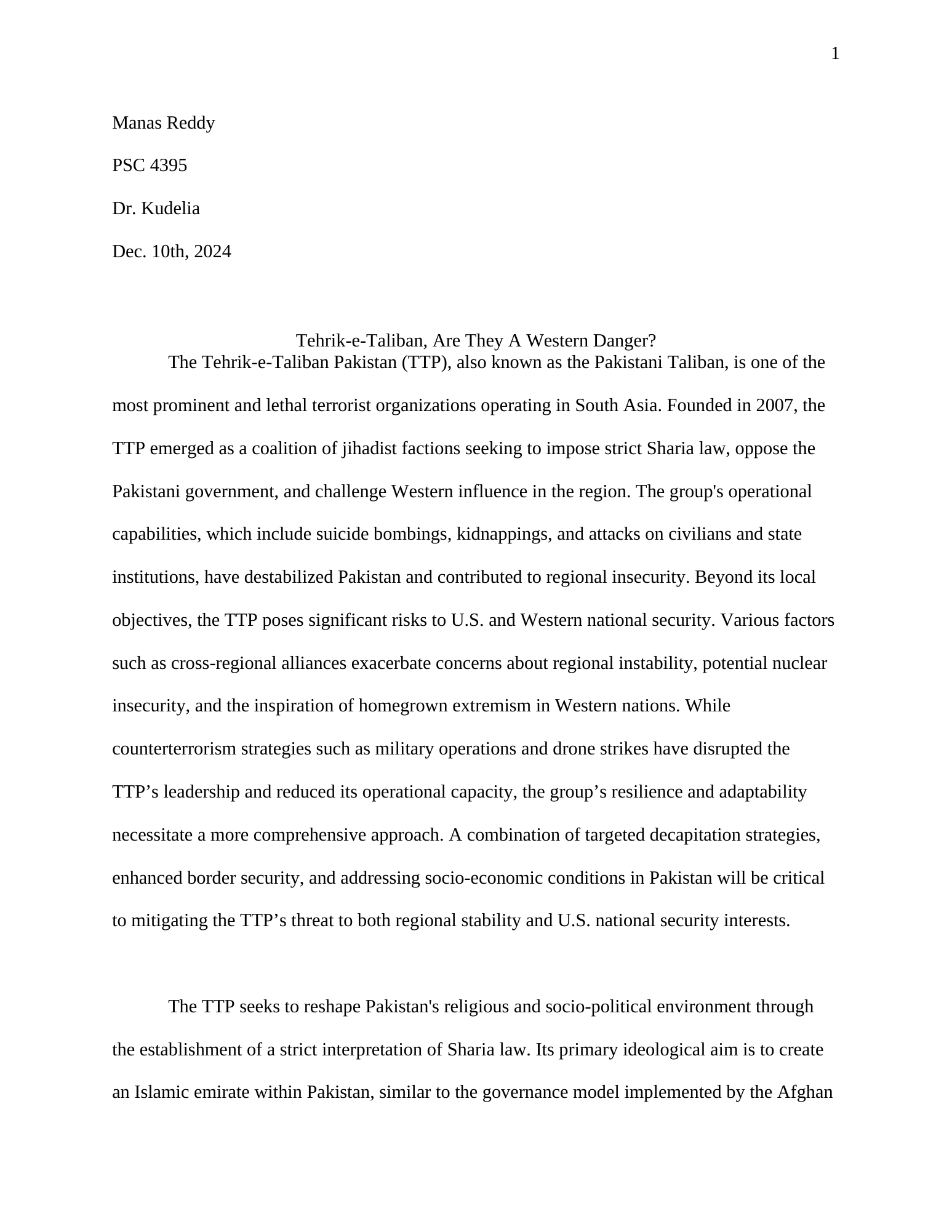
- Saimanas Reddy, Tehrik-e-Taliban, Are They A Western Danger? (2024 academic paper; available below)