Decision Question
Does concentration of influence inside an international organization help explain whether its conflict-mediation efforts succeed?
The practical purpose of the study was to test whether internal structure adds useful information beyond characteristics of the conflict and peace agreement. The original hypothesis expected greater power asymmetry to reduce mediation effectiveness and weaken the durability of settlements.
Bottom Line
The analysis provides partial, not conclusive, support for the hypothesis. In the reported model, power asymmetry has a weak and statistically insignificant direct relationship with the conflict-intensity outcome. Agreement type and conflict type explain more of the observed variation. A survival-analysis visualization suggests a possible relationship between asymmetry and agreement durability, but that pattern should be treated as hypothesis-generating until its uncertainty and robustness are tested more fully.
Data and Method
The project combined three public sources:
- An IGO-year dataset for membership and institutional characteristics.
- The Uppsala Conflict Data Program Peace Agreements dataset.
- The UCDP armed-conflict dataset for conflict type, intensity, and duration.
Power concentration was operationalized with a Herfindahl Index. The workflow used OLS and logistic regression to examine mediation outcomes and a Kaplan-Meier approach to explore agreement durability. Conflict type and agreement type were included as alternative explanations.
Findings
Direct Effect
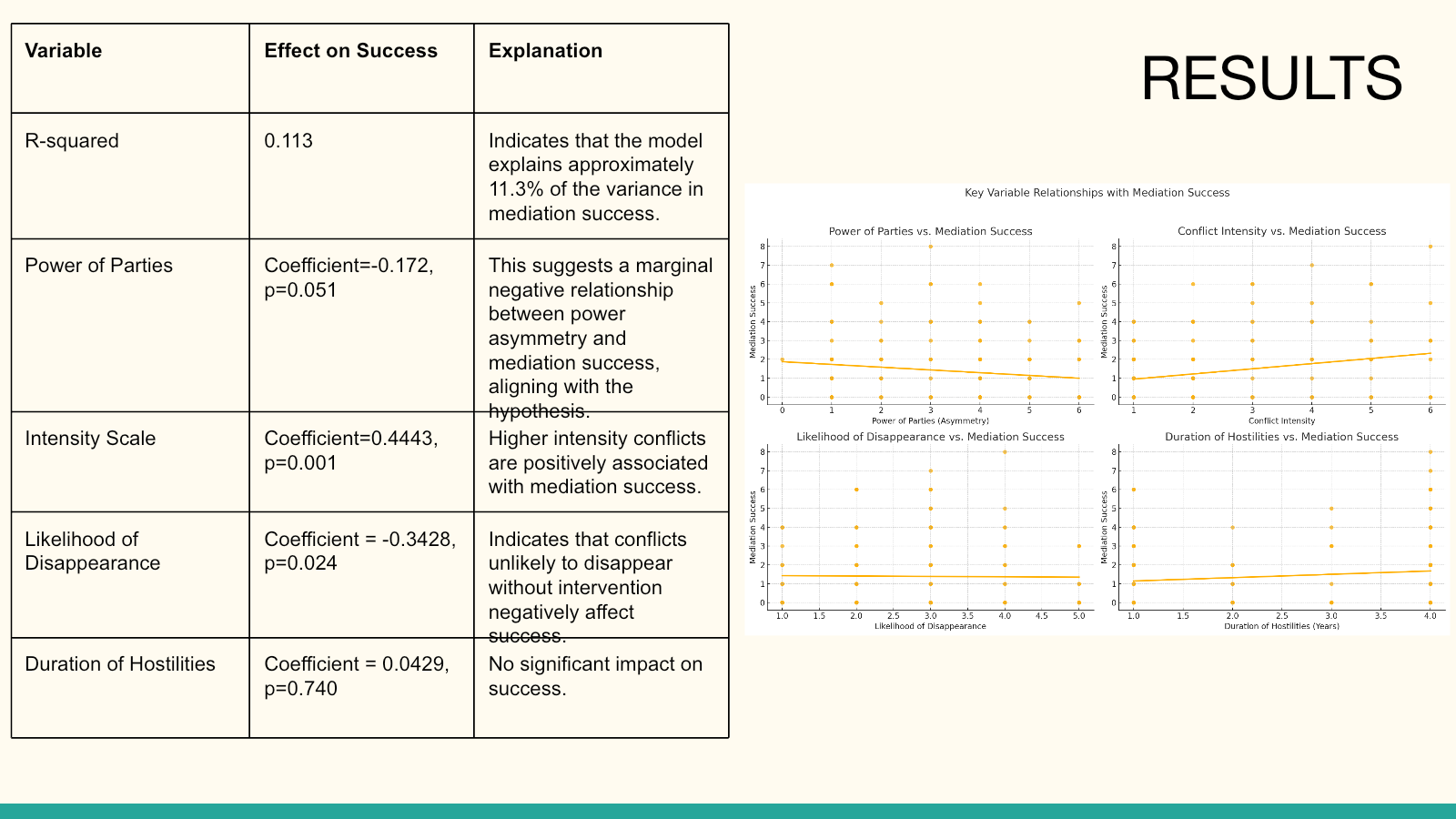
The reported coefficient for power asymmetry was negative but not statistically significant (p = 0.685 in the documented model). The result does not justify claiming that power asymmetry independently predicts the measured conflict-intensity outcome.
Other Variables
Peace-agreement type and conflict type were statistically significant in the reported specification. That result indicates the immediate characteristics of a conflict and the form of agreement may be more informative than internal IO power concentration for the selected dependent variable.
Model Fit
The original output described model fit as very low. A model that explains only a small portion of the outcome variation should not be used as a stand-alone basis for institutional reform.
Durability Pattern
The Kaplan-Meier visualization appeared consistent with earlier breakdown among higher-asymmetry groups. The academic paper described this as evidence that power structure matters more for longevity than for initial mediation success. The disciplined interpretation is narrower: the visualization identifies a pattern worth testing, not a causal conclusion.
What I Would Change
- Align the outcome to the question. Separate initial agreement, intensity reduction, and agreement durability rather than treating them as interchangeable definitions of effectiveness.
- Report the sample and missingness clearly. The reader needs to know how cases were joined across datasets and which observations were excluded.
- Show complete model diagnostics. Include sample size, coefficients, confidence intervals, fit statistics, and sensitivity to alternative specifications.
- Test the survival result. Report group sizes, confidence bands, log-rank tests, and a Cox model with relevant controls.
- Avoid causal language. Institutional structure may correlate with outcomes while also reflecting membership, resources, conflict selection, or geopolitical context.
Decision Relevance
The current evidence is not strong enough to recommend changes to IO voting or resource-allocation rules. It is strong enough to justify a better-designed follow-on study focused on agreement durability. That next study should define the decision in advance: whether institutional reform is expected to improve impartiality, enforcement, or long-term compliance.
Analytic Lesson
The value of the project is not a dramatic finding. It is the discipline of revising a claim when the model is weaker than the theory. The evidence supports continued investigation and a narrower conclusion—not certainty.
Source Material
- Original academic paper and presentation are available below.
- Data sources cited in the paper include the IGO dataset and UCDP peace-agreement and armed-conflict datasets.